


-
By: admin
- 0 Comments
- Blog
What Are Two Letter Words in English?
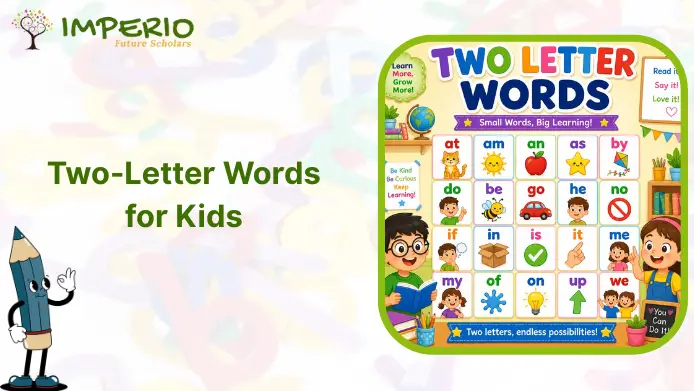
Two letter words in English are foundational building blocks for early readers. These tiny combinations, like at or in, help children transition from recognising single letters to reading full sentences smoothly and confidently every single day of their lives. They are the essential first steps in early literacy.
Benefits Of Learning 2-Letter Words In English For Kids
Knowing how to use two letter words in English can be an excellent way to lead to good literacy. Even though these words are quite small, they entail much. Here we explain how they can be of help to your kid.
- Enables Your Kid To Read Easily – The knowledge of these simple words helps develop reading skills faster. Thus, children will spend less time decoding and more time comprehending the text.
- Boosts Confidence – Being able to identify such simple words gives a sense of accomplishment. This early success encourages them to tackle longer, more complex words later on.
- Grammar Improvement – Many of these short terms are essential prepositions and pronouns. Understanding them early helps children grasp basic sentence structure and how words connect.
- Phonetics awareness – Blending two distinct sounds teaches basic phonics rules. It helps kids understand how individual letter sounds combine to create new spoken words effectively.
- Two Letter Words Support Early Language And Communication Growth – Learning two letter words allows children to communicate their desires better. These words act as a bridge between their babbling and the ability to think simple sentences.
List of Common Two Letter Words in English for Kids
Here is a helpful list of twenty five common two letter words in English that every early reader should know. Memorizing this specific list will give them a huge advantage. Practice these daily for the best results.
| Word | Usage Example |
| am | I am happy. |
| an | She ate an apple. |
| as | He works as a teacher. |
| at | Meet me at school. |
| be | Always be kind. |
| by | The cat sat by the door. |
| do | Please do your homework. |
| go | Let’s go home. |
| he | He is my friend. |
| if | If it rains, stay inside. |
| in | The toys are in the box. |
| is | She is reading. |
| it | It is raining. |
| me | Please help me. |
| my | This is my book. |
| no | No pets are allowed. |
| of | A cup of tea. |
| on | The book is on the table. |
| or | Tea or coffee? |
| so | I was tired, so I slept. |
| to | We walked to the park. |
| up | Climb up the stairs. |
| us | Please join us. |
| we | We are classmates. |
| Ok | OK, let’s begin. |
Simple Ways to Practice Two Letter Words
You don’t need a lesson plan or a strict schedule to teach two letter words. Most of the learning happens in the small moments you’re already having with your child, like snack time, the walk to the park, or bath time. Slip these tiny words into what you’re already doing, and reading starts to feel less like a chore and more like something your child stumbled into on their own.
- Turn everyday moments into a game – Next time you’re out for a walk or unpacking groceries, ask your child to spot short words on cereal boxes or street signs. It costs nothing, takes two minutes, and doesn’t involve a screen, which is usually a win for everyone.
- Pause during storytime – When you’re reading a familiar picture book together, stop for a second whenever a short word pops up, like “it,” “at,” “in.” Point it out. That little pause does something important: it shows your child they can already read parts of a real book, not just flashcards.
- Build tiny sentences – Once your child knows a few short words, pair them with names or everyday actions, such as “go in,” “sit up,” “at home.” These little phrases are the bridge between recognising single words and actually using language to say something.
- Make it physical – Chalk on the sidewalk or tape on the floor works well here. Write out a short word and have your child stomp, jump, or clap on each letter as they sound it out. Kids at this age learn better with their whole body involved, not just their eyes.
- Lean on sight words – Some words show up so often, like “the,” “to,” “in,” that sounding them out every single time slows a child down. The goal with these is instant recognition, not decoding, and that recognition is what eventually makes reading feel smooth instead of effortful.
Fun Activities and Games to Learn Two Letter Words in English
Keeping things active and hands-on matters more than most people expect. A child who’s moving, touching, or playing is far less likely to feel overwhelmed than one sitting still with a worksheet.
1. Flash cards, but fast
Keep the sessions short, a couple of minutes, tops. Flip through a small stack, throw in a silly voice or two, and stop before it gets boring. Brief and playful beats long and thorough almost every time at this age.
2. Reusable story mats
Some learning mats let kids place word tiles onto a scene, like a barn, a park, or a kitchen. When the word “go” ends up next to a picture of a running dog, the meaning clicks in a way that flashcards alone can’t manage.
3. Magnetic letters on a tray
A cheap set of fridge magnets and a baking sheet is really all you need. Let your child snap letters together to build words. There’s something about physically moving the pieces that makes the structure of a word click.
4. A round of word bingo
Games like Boom Boom Bingo work because there’s a small reward attached to recognising a word quickly. The stakes are low, but the motivation is real. Kids like winning, even at word games.
5. Fill-in-the-blank sentences
Write a simple, half-finished sentence on a whiteboard and hand your child a word card to complete it. It’s a small moment, but finishing a sentence on their own gives kids a genuine sense of “I did that.”
Tips to Teach Two Letter Words to Kids
- There’s no trick to this, just patience and a bit of consistency – Start with what’s familiar. Words your child already says out loud, like “go,” “on,” “up,” are the easiest entry point, because there’s no new vocabulary to learn, just a new way of seeing it written down.
- Pair words with real things – A printed word next to the actual object, or a clear picture of it, helps the connection stick faster than the word on its own.
- Keep the mood light – High-fives, silly songs, a bit of over-the-top praise. None of it needs to be sophisticated; it just needs to make reading feel good.
- Repeat, but don’t drill – Bring the same words back throughout the week in different settings. Repetition works quietly, without needing to feel like practice.
- Talk before you read – Encourage your child to use the word out loud in a sentence before they try reading it. Speaking it first makes the written word easier to recognise later.
Conclusion
A little patience, some repetition, and a willingness to turn ordinary moments into small reading opportunities go a long way. If you’re looking for a place that treats early literacy this way- playful, unhurried, and genuinely supportive- it’s worth exploring a preschool or day care in Gurgaon built around that same approach.
FAQs of two letter words for kids
What are some common two-letter words for kids?
The usual starting point is words like in, on, at, to, go, no, it, and am, the words that show up constantly in early sentences.
What’s the best age to start?
Most kids are ready around three to four years old, once they’ve got a handle on individual letters and basic sounds.
How do phonics and two-letter words connect?
Phonics is really about blending sounds; /a/ and /t/ coming together to make “at” is a perfect first example.
Are two-letter words okay for toddlers?
Yes, as long as it stays playful: songs, pictures, and books, with no pressure to write or memorise anything yet.
Do two-letter words actually matter in grammar?
They matter more than they get credit for. A lot of them are prepositions, pronouns, and verbs that hold a sentence together.
