


-
By: admin
- 0 Comments
- Blog
Ever notice the exact moment a toddler’s communication shifts? It usually looks something like this: instead of just pointing at a toy and grunting “Ball!”, they suddenly look up at you and shout, “Kick ball!” That little shift is a massive milestone, and it’s entirely powered by action words for kids.
What Are Action Words for Kids?
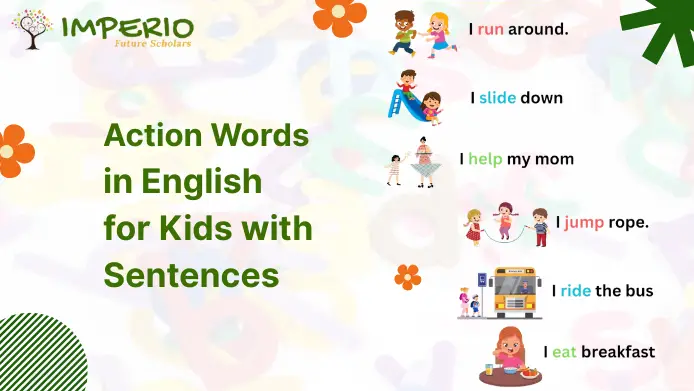
Action words (or verbs) are the literal engines of speech. They are the “doing” words, like run, eat, jump, and sleep. For young kids, unlocking these words is the key to the castle. It’s the moment they stop just naming the objects around them and start building real, live sentences. Because almost every sentence needs a verb to function, teaching kids action words is like handing them the keys to express what they actually want, think, and feel.
Benefits of Learning Action Words for kids
We often focus on teaching toddlers nouns, names of animals, colours, and shapes. But action words in English quietly do some incredible behind-the-scenes work for a child’s development:
- Enhance real communication: Nouns let a child label the world, but verbs (action words) let them interact with it.
- Strengthens grammar: You don’t need to teach a three-year-old sentence structure rules. When they learn verbs, they naturally figure out how sentences fit together just by playing.
- Helps children describe daily activities: When a child can say “I brush” or “Me cook,” they are actively narrating and understanding their own routines.
- Enhances storytelling and creative writing: A child with a healthy bank of action words in English can tell you what happened at the park, making their thoughts livelier and way easier to follow.
- Builds confidence in spoken English: There is less frustration and fewer tantrums when a child can clearly tell you exactly what they want to do, rather than just pointing and hoping you guess right.
List of 100 Action Words in English with Sentences
You don’t need to sit your child down with a dictionary. The best way to use these words is to naturally weave them into your conversations, playtime, and daily routines.
Here are 100 simple action words split by how kids actually experience them every day:
| No. | Action Word | Sentence |
| 1 | Start | I start my work. |
| 2 | Stop | He stops the car. |
| 3 | Turn | She turns left. |
| 4 | Move | They move quickly. |
| 5 | Wait | I wait for the bus. |
| 6 | Call | She calls her friend. |
| 7 | Answer | He answers the phone. |
| 8 | Ask | I ask a question. |
| 9 | Reply | She replies quickly. |
| 10 | Think | He thinks deeply. |
| 11 | Know | I know the answer. |
| 12 | Understand | She understands the lesson. |
| 13 | Forget | He forgets his keys. |
| 14 | Remember | I remember your name. |
| 15 | Believe | She believes in herself. |
| 16 | Hope | We hope for success. |
| 17 | Love | I love my family. |
| 18 | Like | She likes ice cream. |
| 19 | Hate | He hates noise. |
| 20 | Enjoy | They enjoy the game. |
| 21 | Sing | She sings beautifully. |
| 22 | Dance | We dance at parties. |
| 23 | Laugh | He laughs loudly. |
| 24 | Cry | The baby cries at night. |
| 25 | Smile | She smiles at me. |
| 26 | Help | I help my mother. |
| 27 | Teach | She teaches English. |
| 28 | Learn | I learn new words daily. |
| 29 | Build | They build a house. |
| 30 | Draw | He draws a picture. |
| 31 | Paint | She paints a wall. |
| 32 | Cut | He cuts vegetables. |
| 33 | Break | She breaks the glass. |
| 34 | Fix | I fix my bike. |
| 35 | Buy | She buys groceries. |
| 36 | Sell | He sells fruits. |
| 37 | Give | I give him a gift. |
| 38 | Take | She takes a photo. |
| 39 | Bring | He brings food. |
| 40 | Carry | She carries a bag. |
| 41 | Push | He pushes the door. |
| 42 | Pull | She pulls the rope. |
| 43 | Throw | He throws the ball. |
| 44 | Catch | She catches it easily. |
| 45 | Kick | He kicks the ball. |
| 46 | Climb | She climbs a tree. |
| 47 | Dig | He digs a hole. |
| 48 | Plant | They plant trees. |
| 49 | Water | She waters the plants. |
| 50 | Grow | Plants grow fast. |
| 51 | Sleep | I sleep early. |
| 52 | Wake | She wakes up early. |
| 53 | Wash | He washes his hands. |
| 54 | Brush | She brushes her teeth. |
| 55 | Wear | He wears a jacket. |
| 56 | Change | She changes clothes. |
| 57 | Travel | We travel often. |
| 58 | Visit | They visit grandparents. |
| 59 | Enter | He enters the room. |
| 60 | Leave | She leaves early. |
| 61 | Try | I try my best. |
| 62 | Win | She wins the match. |
| 63 | Lose | He loses the game. |
| 64 | Work | I work hard. |
| 65 | Rest | She rests after work. |
| 66 | Plan | We plan a trip. |
| 67 | Decide | He decides quickly. |
| 68 | Choose | She chooses a dress. |
| 69 | Create | He creates art. |
| 70 | Design | She designs clothes. |
| 71 | Improve | I improve my skills. |
| 72 | Practice | She practices daily. |
| 73 | Share | He shares his food. |
| 74 | Save | I save money. |
| 75 | Spend | She spends wisely. |
| 76 | Protect | He protects his family. |
| 77 | Support | We support each other. |
| 78 | Follow | She follows rules. |
| 79 | Lead | He leads the team. |
| 80 | Achieve | I achieved my goals. |
| 81 | Run | I run every morning. |
| 82 | Eat | She eats an apple daily. |
| 83 | Drink | He drinks water after exercise. |
| 84 | Walk | They walk in the park. |
| 85 | Read | I read a book at night. |
| 86 | Write | She writes in her diary. |
| 87 | Speak | He speaks English fluently. |
| 88 | Listen | We listen to music together. |
| 89 | Watch | I watch movies on weekends. |
| 90 | Play | Children play in the garden. |
| 91 | Cook | She cooks delicious food. |
| 92 | Clean | He cleans his room daily. |
| 93 | Jump | The dog jumps high. |
| 94 | Sit | Please sit here. |
| 95 | Stand | They stand in a line. |
| 96 | Open | She opens the door. |
| 97 | Close | He closes the window. |
| 98 | Drive | I drive to work. |
| 99 | Ride | She rides a bicycle. |
| 100 | Swim | They swim in the pool. |
Tips to Guide Action Words to Kids in English
Because these are doing words, the absolute best way to learn them is by doing them! You don’t need worksheets, just real life.
- Use Pictures and Flashcards: Visual cards help children instantly pair a colorful image with a brand-new “doing” word. Pointing to a picture of someone running or swimming anchors the vocabulary in their mind much faster than plain text.
- Storytelling: Weaving action words into exciting bedtime tales lets kids hear exactly how verbs function in real context. Hearing a story about a rabbit who hopped or an astronaut who zoomed helps them absorb grammar naturally.
- Make Story Time Engaging: Instead of just reciting words that you see on a page, do things which reflect verbs through your voice, actions, and hand movements. For instance, if you read “The rabbit jumped!”, you could show it as a movement using your hand.
- Role Play: Ask your child to imagine and act like different animals or other types of characters. Your child can also pretend to be something else, such as a fireman or a nurse.
Conclusion
This is an amazing base for fluent English speaking that comes with practising these words every day through easy play.
If you are searching for the perfect place where your child will develop language skills from a very early age, then a good preschool or a day care centre in Gurgaon will do the job. A warm, interactive social setting gives kids the perfect place to put these new action words into daily practice with friends their own age!
FAQ’s of Action words for kids
At what age do kids actually start picking up action words?
Most toddlers start grabbing onto simple action words like eat, run, and sleep between the ages of 2 and 3. This is usually right around the exact same time they start trying to piece together short, two-to-three-word sentences.
How do I help my kid spot an action word in a sentence?
Keep it super simple. Just ask them: “What is the person or the animal doing?” In a sentence like “The dog barks at the mailman,” the word barks is the action.
Can action words really prevent toddler frustration?
Yes! Many toddler tantrums occur just because they cannot communicate their desires. With the help of action words, they can move from crying to saying things like “Help me” or “Open this,” making it easier for everyone involved.
What’s the difference between “action words” and “verbs”?
They are the same thing! “Action words” is just the friendly, kid-approved term we use in early childhood education before introducing formal grammar terms down the road.
What’s the absolute easiest way for a kid to remember these?
Movement, hands down. When a child physically acts out a word while saying it, like literally jumping up and down while shouting the word “jump!”, the concept locks into their brain way deeper than reading it off a screen ever could.
