


-
By: admin
- 0 Comments
- Blog
Learning opposite words in English is a big step for children as they start to talk and explore. It helps them understand how things are different from each other. By learning these pairs, kids can describe what they see and how they feel much better. This builds a strong base for reading and helps them think more clearly every day.
What are Opposite Words for Kids?
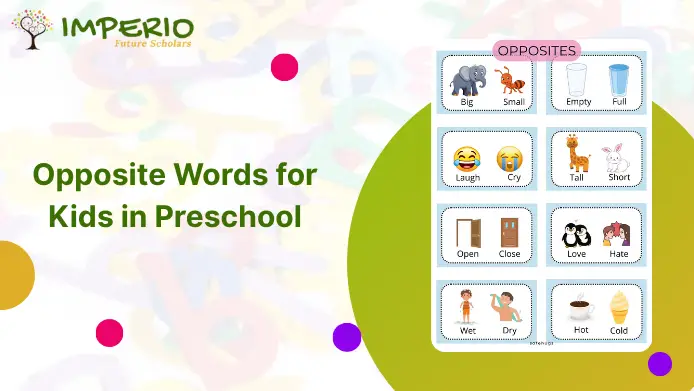
Opposite words are commonly referred to as antonyms. Antonyms are those words that have meanings contrary to each other. In other words, an example of opposite words in English could be big and small. Here, big refers to something being huge or large, while small means something is tiny in size.
List of 50 Opposite Words in English for Kids with Examples
Learning an opposite words list is the fastest way to grow a child’s vocabulary. Below are 50 opposite words in English that are easy for young learners to practice every day. These English opposite words are perfect for building basic language skills.
| Word | Opposite | Example |
| Big | Small | The elephant is big, and the mouse is small. |
| Hot | Cold | The tea is hot, but the ice cream is cold. |
| Fast | Slow | The cheetah is fast, and the turtle is slow. |
| Happy | Sad | She feels happy today, not sad. |
| Up | Down | The balloon goes up, and the ball falls down. |
| Open | Close | Please open the door and then close it. |
| Tall | Short | The giraffe is tall, but the goat is short. |
| Day | Night | We play in the day and sleep at night. |
| Clean | Dirty | His clothes are clean, not dirty. |
| In | Out | The cat is in the box, not out. |
| Full | Empty | The glass is full, not empty. |
| Light | Dark | The room is light during the day, dark at night. |
| Old | Young | My grandfather is old, but I am young. |
| Hard | Soft | The rock is hard, but the pillow is soft. |
| Near | Far | The school is near, not far. |
| Early | Late | I woke up early, not late. |
| Wet | Dry | My clothes are wet after rain, not dry. |
| Laugh | Cry | The baby will laugh, not cry. |
| Give | Take | Please give the book, don’t take it away. |
| Come | Go | Please come here, don’t go away. |
| Start | Stop | Let’s start the game, not stop it. |
| Push | Pull | Push the door, don’t pull it. |
| Buy | Sell | We buy fruits, not sell them. |
| Above | Below | The fan is above, not below. |
| Inside | Outside | Stay inside, not outside. |
| Thick | Thin | This book is thick, not thin. |
| Strong | Weak | He is strong, not weak. |
| Right | Wrong | This answer is right, not wrong. |
| Same | Different | Our bags are different, not the same. |
| Sweet | Sour | The mango is sweet, not sour. |
| New | Old | I have a new toy, not an old one. |
| Heavy | Light | This bag is heavy, not light. |
| Loud | Quiet | The music is loud, not quiet. |
| Bright | Dull | The sun is bright, not dull. |
| Safe | Unsafe | This place is safe, not unsafe. |
| Kind | Mean | She is kind, not mean. |
| Rich | Poor | He is rich, not poor. |
| Easy | Difficult | This question is easy, not difficult. |
| Empty | Full | The box is empty, not full. |
| Win | Lose | Our team will win, not lose. |
| Begin | End | The show will begin now, not end. |
| Sit | Stand | Please sit, don’t stand. |
| Laugh | Weep | He will laugh, not weep. |
| High | Low | The kite is flying high, not low. |
| Front | Back | The teacher stands in front, not at the back. |
| Warm | Cool | The weather is warm, not cool. |
| Enter | Exit | Please enter the room, don’t exit. |
| On | Off | Turn the light on, not off. |
| Before | After | Finish your homework before dinner, not after. |
| Sharp | Blunt | The knife is sharp, not blunt. |
Benefits of learning Easy Opposite Words in English for Kids in English
There are numerous benefits of teaching opposite words for kids.
- Development of vocabulary: It enables them to acquire two words simultaneously.
- Development of thinking skills: They gain knowledge about how to make comparisons.
- Effective communication: An expanded vocabulary gives kids the ability to convey their feelings precisely.
- Preparation for future learning: This will enable them to understand scientific and mathematical concepts better in the future.
- Clear writing: The use of accurate opposites makes it simpler for kids to write.
Fun Ways to Teach Opposites for Kids
The following activities will definitely make the process of learning words in opposite pairs more entertaining.
- Use Examples from Reality: Show opposite pairs in reality. You may demonstrate opposite weight by pointing at a heavy chair and a light feather.
- Games: Involve children in fun activities like the game of Simon Says which can be played using opposite words – ask kids to stand up and then to sit down.
- Narrating Stories: Choose stories with heroes that have different qualities – a fast runner and a slow walker.
- Flash Cards: Demonstrate the meaning of opposite words by using images.
- Practice Words: Use words in daily routine, discussing such notions as dry/wet towel when children washed their hands.
- Role-Playing Activities: Involve children in acting out opposite emotions like happiness and sadness.
Conclusion
Learning the concept of opposites among kids is very easy but very effective in terms of teaching them language skills. Regardless of whether you are taking them to preschool in Gurgaon or even day care in Gurgaon, such lessons will remain etched in their memories forever. Every day practice can make your child a great communicator.
FAQ’s of Learning Opposite Words in English for Kids in Preschool
At what age should kids start learning opposite words?
Most children are ready to start learning basic opposites around age 3 or 4 when they begin to describe the world.
How can parents make learning opposite words fun at home?
Make it into a fun game activity by pointing out an object and asking your child to give its opposite word.
Why is it important to teach opposite words to kids?
This makes it possible for children to learn new words and understand the connection between various concepts.
Are opposite words part of preschool learning?
Yes, they are a standard part of the preschool curriculum to help kids develop their descriptive language and communication skills.
What is the concept of english opposite words?
The concept is based on antonyms, which are words that represent the total reverse or contrary meaning of each other.
